 English
 Spanish
 French
 Italian
 German

SEPTEMBER 21, 2021
Characterization of comorbidity heterogeneity among 13,667 patients with hidradenitis suppurativa
Summary Verified By: Kavita Sarin, M.D. Ph.D. | Stanford University
September 21, 2021
This plain-language research summary was generated by AI, courtesy of HS Simplified.
Characterization of comorbidity heterogeneity among 13,667 patients with hidradenitis suppurativa
In this 2021 article, researchers investigate hidradenitis suppurativa (HS), a chronic inflammatory skin disease marked by painful lump formations under the skin, exploring its link to various associated health conditions. They analyze data from 13,000 HS patients to understand how these comorbidities vary across race and sex, identifying significant patterns that could help target early interventions for those at greatest risk.
What is Hidradenitis Suppurativa (HS)?
Hidradenitis suppurativa, or HS, is a long-lasting skin disease. It causes painful lumps, deep bumps, and tunnels under the skin that can leak pus and leave scars. These usually appear in places where skin rubs together, like the armpits or groin. HS can make life very difficult for people who have it.
Who Gets HS?
HS affects about 1 out of every 100 people in the US and Europe. Most people with HS are women, and the disease is more common and often more severe in Black people. In this study, the researchers, led by Huang, looked at over 13,000 people with HS from a huge health database in the US. They compared them with over 130,000 people without HS.
What Other Health Problems Come With HS?
The scientists found that people with HS are much more likely to have other health problems, called comorbidities, than people without HS. These include:
- Metabolic diseases like high blood pressure, diabetes, high cholesterol, and obesity
- Autoimmune diseases such as rheumatoid arthritis and inflammatory bowel disease (where the immune system attacks the body)
- Mental health concerns like depression, anxiety, and substance use
- A much higher chance of skin infections like cellulitis (an infection of the skin and tissues underneath)
- Polycystic ovary syndrome (PCOS) in women, a hormone problem that can cause irregular periods and other symptoms
- Squamous cell carcinoma (SCC), a type of skin cancer, especially in women with HS
Are Some Groups at Higher Risk?
Most of the extra health problems with HS were seen in all races and both men and women. However, some differences stood out:
- Heart attacks and strokes were more common in White and Black people with HS, but not in Asian or Hispanic people with HS.
- Skin cancer was mostly seen in White women with HS.
- In Asian people, HS was sometimes milder and often happened alongside acne.
Different Types of HS Patients
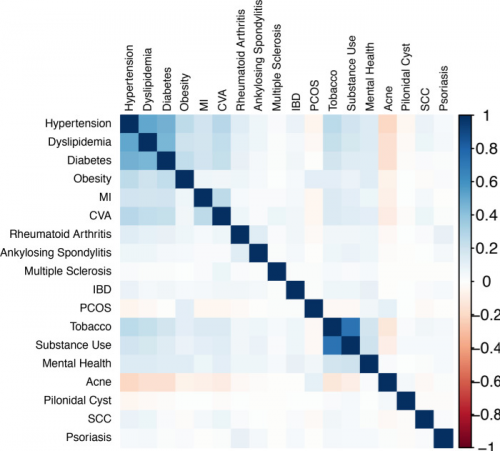
Using computer analysis, Huang and colleagues found that people with HS could be grouped into six main types based on their other health problems:
- People with metabolic syndrome (high blood pressure, diabetes, etc.)
- People with both metabolic and autoimmune diseases
- Those with substance use problems
- Those who mainly had acne
- Women with PCOS, obesity, and acne
- A “mild” group with few extra health problems
The oldest and sickest group (with both metabolic and autoimmune diseases) had the most severe HS and the most hospital visits for infections like cellulitis.
What Does This Mean for Patients?
This study shows that people with HS should be checked for many other health problems, not just skin issues. Doctors should pay special attention to older men with HS who have heart, autoimmune, or substance use problems, as they may have the most severe disease and the highest risk for complications.
It’s also important for Asian patients and people with a history of acne or pilonidal cysts (a type of cyst near the tailbone) to be watched carefully, since their HS may be different from others.
Limitations of the Study
This research used health insurance records, which don’t always have full details. For example, the severity of people’s skin problems wasn’t directly measured, and the data might miss people with very mild or very severe HS. Also, the study can’t prove what causes what—it only shows connections between HS and other diseases, not which comes first.
Why This Matters
This study helps doctors understand that HS is more than a skin disease. It’s linked to many other health problems, and people with HS need careful, whole-body care. Knowing the different “types” of HS patients can help doctors give the right treatment and support to those who need it most.
Author(s)
Vivian J. Hua, James M. Kilgour, Hyunje G. Cho, Shufeng Li, Kavita Y. Sarin
Read Original Paper
https://insight.jci.org/articles/view/151872