 English
 Spanish
 French
 Italian
 German

NEWS
Latest News

Now Available! Guidelines of Care for the Management of HS
October 20, 2026
The wait is over! For the first time, the American Academy of Dermatology and the HS Foundation have come together to publish joint clinical care guidelines for hidradenitis suppurativa. These evidence-based recommendations give dermatologists and clinicians a clear, trusted roadmap for diagnosing and managing HS.
Read more

HS Is a Systemic Disease. The Evidence Base Has to Reflect That.
October 12, 2026
Hidradenitis suppurativa isn't only a skin disease. HS Foundation Secretary Dr. Amit Garg explains how large-scale data has linked HS to inflammation across nearly every organ system. He also covers what that means for clinicians and payers, and why better ways to measure treatment response are key to getting new therapies through trials.
Read more

Beyond the Surface: October 2026
October 7, 2026
Catch the latest from the Hidradenitis Suppurativa Foundation - final days to register for SHSA 2026 in Tucson, open research grant opportunities, new HS clinical guidelines coming this fall, and a celebration of our scholars, ambassadors, and new partners.
Read more
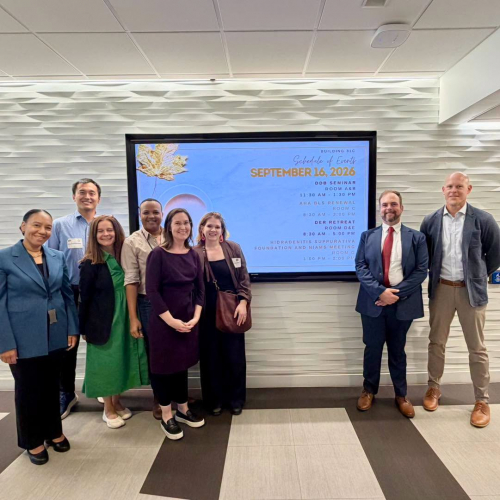
HSF Leadership Advocates with Several NIH Institutes
October 6, 2026
For the fourth consecutive year, HS Foundation met at the National Institutes of Health to raise the profile of HS research across the agency. Drs. Alex Charrow, Lauren Orenstein, Leo Wang & Irena Pastar, as well as CEO Brent Hazelett & patient representative, Taylor Reslow, met with leadership from NIAMS, NIAID, NCCIH, OADR, NIEHS, NICHD & NCATS. Learn more about how HSF is building cross-institute interest in HS & stronger collaboration between the HS research community & NIH.
Read more

Guidelines Are a First Step. The Harder Work Comes Next.
September 21, 2026
HSF President Dr. Haley Naik reflects on nearly two decades treating hidradenitis suppurativa, from a time with no approved therapies to today's landscape of three FDA-approved options and a growing pipeline. In a new op-ed, she previews the upcoming joint AAD/HSF clinical management guidelines, why timely systemic treatment matters, and the three priorities that will determine whether this milestone actually changes patients' lives: access, research, and maintenance.
Read more

GLP-1 Receptor Agonist Use and Clinical Outcomes in Patients With Hidradenitis Suppurativa
September 19, 2026
New research just published in JAMA Dermatology: in a study of over 40,000 people with HS, those taking GLP-1 medications (like semaglutide and tirzepatide) saw significantly lower rates of death, cardiovascular events, and serious infections compared to those who weren't. 📚 More research is needed to understand why, but it's a promising sign for whole-body care in HS. Read the full study for more information.
Read more
Biologic Therapy in Pediatric Hidradenitis Suppurativa: New Approvals, New Questions
September 8, 2026
Nearly half of people with hidradenitis suppurativa report symptoms starting in childhood, yet treatment options for young patients have long lagged behind those for adults. A new article from The Dermatologist explores how two recently approved biologics, adalimumab and secukinumab, are changing that picture, and why treating early may help prevent the scarring that comes with delayed care. Read the full piece to learn what this means for adolescents with HS and their families.
Read more

Ultrasound as a Transformative Tool in Dermatology
September 3, 2026
Could ultrasound be the key to faster HS diagnosis? Dermatologists are using high-frequency imaging to spot subclinical tunnels and inflammation invisible to the naked eye, potentially cutting years off the diagnostic delay HS patients face. Read how this "fourth eye" is changing the way clinicians see and treat HS.
Read more

There Was No Playbook for HS Care. There Is One Now.
August 25, 2026
"HS is becoming a disease the community can treat, not something only specialty clinics know how to manage." Three newly approved therapies, a pipeline of oral and biologic options, and updated clinical guidelines with a live-update process are reshaping how HS gets treated, and why medication and surgery now work best together, not as either/or options. Read the full piece to see what's changed.
Read more
HS Immunopathogenesis Drives Expansion of Targeted Therapeutic Strategies
August 21, 2026
At Music City SCALE 2026, Dr. James Krueger outlined how new insights into HS's immune drivers, from neutrophil-heavy inflammation to a surprisingly strong B-cell and plasma cell signature, are reshaping the treatment pipeline. He pointed to CXCL13 and Bruton's tyrosine kinase as emerging targets alongside the more established IL-17, TNF, OX40L, and IL-1 pathways. The result is a fast-expanding pipeline, including JAK1 inhibitors for patients who fail TNF inhibitors, bispecific antibodies, and novel nanobody-based treatments, aimed at matching therapy to HS's diverse immune profile.
Read more