 English
 Spanish
 French
 Italian
 German

JANUARY 1, 2024
Clascoterone in the treatment of mild hidradenitis suppurativa
Summary Verified By: Hadar Lev-Tov, M.D. | University of Miami Miller School of Medicine
January 1, 2024
This plain-language research summary was generated by AI, courtesy of HS Simplified.
Clascoterone in the treatment of mild hidradenitis suppurativa
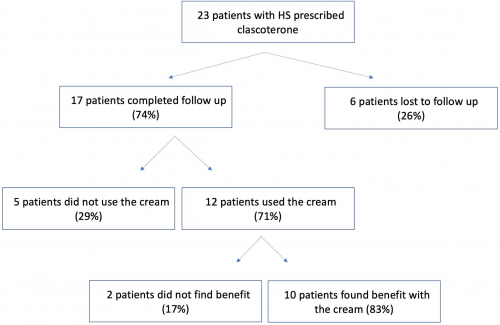
In a 2024 study detailed in Scientific American, researchers explored the potential of clascoterone cream, traditionally used for acne, as a treatment for mild hidradenitis suppurativa (HS)—a chronic inflammatory skin disease characterized by painful nodules. Utilizing data from 12 patients, the study found that 83% reported improvements without significant side effects, highlighting clascoterone's promise as a well-tolerated option targeting the hormonal aspect of HS. The findings suggest a promising addition to limited treatment options, although larger, controlled studies are needed for validation.
Clascoterone Cream for Mild Hidradenitis Suppurativa: A New Option?
Hargis and coworkers wanted to see if a skin cream called clascoterone could help people with mild hidradenitis suppurativa (HS). HS is a skin disease where painful nodules, tunnels, and scars form, usually in places where skin touches skin, like underarms. Mild HS is common, but not well-studied, so there are limited proven treatments for it.
HS seems to be partly caused by hormones, especially androgens (male-type hormones both men and women have). The skin in people with HS has more androgen receptors (spots that hormones attach to) than normal. Some medicines, like spironolactone, block these receptors, but spironolactone has risks—such as altering blood pressure, disruption of hormonal signaling, and possible cancer risk (but this has only been seen in animal studies at extremely high doses).
Clascoterone is a newer medicine that blocks these hormone receptors but is a cream you put on your skin. It's already approved for acne. In this study, doctors gave clascoterone cream to people with mild HS who still had nodules, even if they were already using other treatments. People with more severe HS (lots of tunnels or scars) didn’t get the cream.
Twelve patients used clascoterone and came back for a check-up. Most were women with an average age of 28. After about 3 months, 10 out of 12 patients (83%) said they felt better. Their nodules were fewer, smaller, and less red. Doctors also saw the improvement. No one had side effects.
Why is this important? Clascoterone cream might be a safe and helpful treatment for people with mild HS, especially those who have active nodules. Since it works on the hormone problem right on the skin, it doesn’t cause the body-wide side effects of pills like spironolactone.
Limitations and What's Next
This study was small and only looked back at the records of people who tried the cream. Most patients were women, and many were also using other medicines at the same time, so it’s hard to be sure the cream alone caused the improvements. Also, the way the doctors measured improvement was new and not standard. Bigger studies, where people are randomly picked to use the cream or not, are needed to prove how well clascoterone really works for mild HS.
Do Delays in Treating Rare Skin Tumors Matter?
Another group of researchers, led by Glazer, studied rare types of skin cancer called cutaneous adnexal tumors. These are cancers that start in sweat glands or oil glands of the skin. The scientists wanted to know if waiting too long to start treatment affects how long people live, and what causes those delays.
They looked at over 6,700 cases from a big database, mostly in older, white men. Most people started treatment quickly, but about 1 out of 5 waited over a month. The good news: delays of more than a month did not make people less likely to survive. In other words, waiting a little longer didn’t seem to make a big difference in how long people lived after getting these rare tumors.
Delays were more likely for people who needed Mohs surgery (a special type of surgery for skin cancer), those whose tumors had spread, or whose tumors were on the head or neck. People treated with regular surgery or who had a certain tumor type (malignant eccrine spiradenoma) got faster care. Having more people born outside the U.S. in a county was also linked to delays, but things like age, race, and income were not.
Limitations
This study looked back at records, so it can't prove cause and effect for every factor. Also, they didn’t include people with missing information, and not all reasons for delays can be measured by numbers in a database.
Takeaway
For these rare skin cancers, waiting a few extra weeks for treatment usually doesn’t affect survival. But it’s still important for doctors to notice when delays happen and try to help people get care as soon as possible, especially for those needing special surgeries or with more serious disease.
Author(s)
Abby Hargis, Marita Yaghi, Narges Maskan Bermudez, Hadar Lev-Tov
Read Original Paper
https://www.jaad.org/article/S0190-9622(23)02651-8/abstract