 English
 Spanish
 French
 Italian
 German

JUNE 8, 2024
Efficacy and Safety of Bimekizumab in Patients with Moderate-to-Severe HS (BE HEARD I and BE HEARD II Phase 3 Trials)
Summary Verified By: Alexa Kimball, MD, MPH | Harvard Medical Faculty Physicians at Beth Israel Deaconess Medical Center
June 8, 2024
This plain-language research summary was generated by AI, courtesy of HS Simplified.
Efficacy and Safety of Bimekizumab in Patients with Moderate-to-Severe HS (BE HEARD I and BE HEARD II Phase 3 Trials)
This study tested bimekizumab, a newer injectable medication that blocks two inflammatory signals, IL-17A and IL-17F. Many people treated with bimekizumab had rapid and lasting improvements, with benefits continuing for up to one year. Side effects were manageable and consistent with what is known about similar immune-targeting drugs.
The BE HEARD trials evaluated a biologic that block inflammations across two relevant pathways. The studies were conducted from 2020 to 2021 across multiple continents, led by international hidradenitis experts and sponsored by UCB Pharma.
What is bimekizumab and how does it work?
Bimekizumab is an injectable medication that targets the immune system to reduce inflammation. It blocks two inflammation signals, called IL-17A and IL-17F, which are both active in hidradenitis. One of these signals, IL-17F, is often present at very high levels in HS patients.
What did the study test?
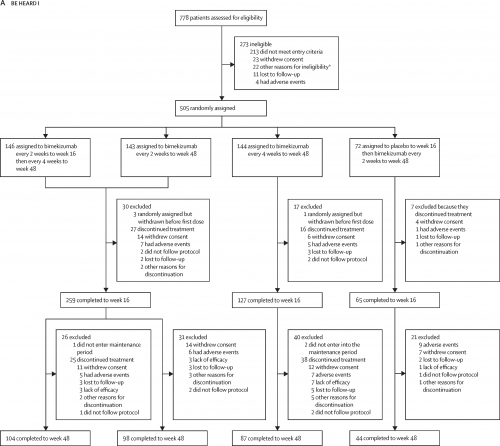
Two nearly identical phase 3 trials tested different dosing schedules of bimekizumab versus placebo. The main goal was to see whether patients achieved at least a 50% reduction in abscesses and inflammatory nodules by week 16, with follow-up through week 48.
What did the study find?
Nearly half to over half of patients receiving bimekizumab achieved meaningful improvement, compared with about 30% on placebo (no drug). Improvements were rapid, often seen by week 16, and were maintained or increased over one year. Higher-level responses (75–90% improvement) were also reported.
Side effects and safety profile
Most side effects were mild to moderate. Common issues included oral yeast infections, headache, and diarrhea, effects consistent with IL-17 blockade. Serious adverse events were uncommon, and no new safety concerns emerged.
What were the study’s limitations?
The studies excluded patients with very severe tunnels, so results may not apply to all disease stages. As with all biologics, long-term real-world effectiveness and access remain considerations.
What does this matter? (Takeaways)
These trials show that dual IL-17 blockade can provide deep and sustained improvement for many patients. Bimekizumab expands the treatment options for people with moderate to severe hidradenitis.
Author(s)
Alexa B Kimball, Gregor B E Jemec, Christopher J Sayed, Joslyn S Kirby, Errol Prens, John R Ingram, Amit Garg, Alice B Gottlieb, Jacek C Szepietowski, Falk G Bechara, Evangelos J Giamarellos-Bourboulis, Hideki Fujita, Robert Rolleri, Paulatsya Joshi, Pratiksha Dokhe, Edward Muller, Luke Peterson, Cynthia Madden, Muhammad Bari, Christos C Zouboulis
Read Original Paper
https://www.thelancet.com/journals/lancet/article/PIIS0140-6736(24)00101-6/abstract