 English
 Spanish
 French
 Italian
 German

JULY 12, 2025
Genetic Signals Linked to HS
Summary Verified By: Christopher Sayed, M.D. | UNC School of Medicine
July 12, 2025
This plain-language research summary was generated by AI, courtesy of HS Simplified.
Genetic Signals Linked to HS
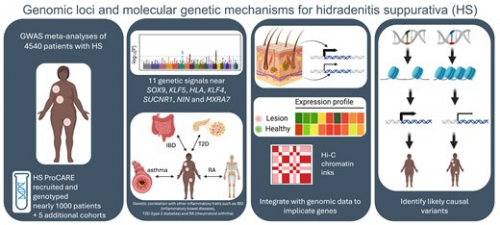
In this 2025 study, researchers investigated the genetics of Hidradenitis Suppurativa (HS), a chronic skin disease causing painful lumps and tunnels in skin folds, linked to genes affecting inflammation and skin cell growth. Utilizing genome-wide association studies (GWAS), they identified 11 key genetic signals, shedding light on HS's genetic foundation and its links to conditions like inflammatory bowel disease. This research enhances our understanding of HS and highlights potential pathways for targeted therapies.
Understanding Hidradenitis Suppurativa (HS) and Its Genetics
Hidradenitis suppurativa (HS) is a long-lasting skin disease. People with HS get painful lumps, abscesses (pockets of pus), and tunnels under the skin, often in places where skin rubs together, like the armpits or groin. HS can make life very uncomfortable and is linked with other problems like psoriasis (a skin disease), inflammatory bowel disease (IBD) (gut inflammation), and polycystic ovary syndrome (PCOS) (a hormone problem).
Why Study the Genes?
HS often runs in families, so scientists think genes play a big role. Genes are instructions in our body that decide how we look and how our bodies work. Scientists have found some rare gene changes in HS, but wanted to know more about common changes that might affect everyone’s risk. To do this, they use a method called a genome-wide association study (GWAS), which looks at DNA from many people to spot patterns linked with the disease.
What Did the Researchers Do?
In this study, the team led by several groups combined genetic data from 4,540 people with HS from different countries and backgrounds. They compared these people to others without HS. They also grouped people by their genetic backgrounds (like African or European ancestry) and by sex to see if there were differences. The researchers used computers to find genetic “signals”—spots in the DNA that are more common in people with HS.
What Did They Find?
The scientists found 11 genetic signals in 7 different places (loci) on the DNA that are linked to HS. Some of these had been found before, but some were new. They discovered that some genes involved are important for skin cells, immune cells, and how the body reacts to inflammation. For example, one important gene, KLF4, helps control how skin heals and fights germs.
They also saw that some genetic signals were found mostly in men or in people from certain backgrounds. This shows that HS can be different depending on your sex and ancestry.
HS and Other Diseases
The study found that some HS genes are also linked to other diseases like asthma, type 2 diabetes, and rheumatoid arthritis (a joint disease). The strongest link was with inflammatory bowel disease (IBD). This means that some of the same body processes might be causing several diseases.
How Do These Genes Work?
The scientists wanted to know how these gene changes might actually cause HS. They did lab experiments using skin cells to see how different DNA versions changed how genes were turned on or off. They found that some gene changes made certain genes much more or much less active, which could lead to the skin problems seen in HS.
Why Is This Important?
By finding which genes are involved in HS, scientists can better understand why the disease happens. This could help doctors find new ways to treat HS, or even prevent it in people who carry certain gene changes. Also, because some genes are shared with other diseases, treatments that work for one disease might help with HS too.
Limitations of the Study
There were some challenges. Most of the people in the study were not from African backgrounds, so the findings may not apply to everyone. Some gene changes are rare in certain groups, making them hard to study. Also, not everyone with the gene changes will get HS, so other things like environment or lifestyle must also matter. Finally, the study mainly looked at common gene changes, so rare ones might still be missing.
Summary
This research is one of the largest of its kind for HS. It found several spots in our DNA that make a person more likely to get HS. The results help us understand how genes and the immune system work together in this painful skin disease. More studies with people from all backgrounds will help us learn even more and find better treatments in the future.
Author(s)
K Alaine Broadaway, Quan Sun, Sharon N Edmiston, Kevin W Currin, Swarooparani Vadlamudi, Tyne W Miller-Fleming, Yue Shi, Kristen Fajgenbaum, Maria Melendez-Gonzalez, Helen Bui, Franklin R Blum, Linnea Westerkam, Rayad Shams, Teja Mallela, Brandt Levitt, Lan Lin, Honglin Hao, Aylin Memili, Peter Straub, Wei Zhou, Kathleen Mullan Harris, Alicia Martin, Nancy J Cox, Zhi Liu, Nancy E Thomas, Yun Li, Karen L Mohlke, Christopher J Sayed
Read Original Paper
https://academic.oup.com/bjd/article/193/5/948/8198020