 English
 Spanish
 French
 Italian
 German


FEBRUARY 26, 2026
Global Pain Management Trends and Barriers to Care in HS
Summary Verified By: Haley Naik, M.D. | University of California, San Francisco
February 26, 2026
This plain-language research summary was generated by AI, courtesy of HS Simplified.
Global Pain Management Trends and Barriers to Care in HS
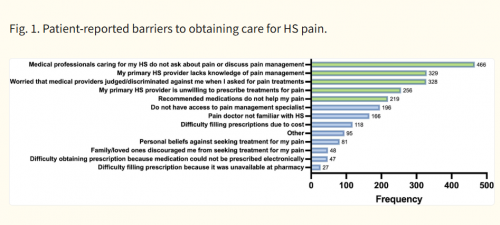
In this 2026 study, researchers surveyed 890 adults with hidradenitis suppurativa across five countries about pain. Moderate and severe pain was associated [NH1.1]with markedly worse quality of life, and 38.4% had never been given a prescription for pain medicine. Patients described providers not asking about pain, lacking knowledge about it, or seeming unwilling to treat it.
Pain is the symptom patients most often name as the hardest part of hidradenitis suppurativa, yet it is frequently absent from clinical records. In a 2026 study, Barnes and colleagues surveyed patients across five countries to measure how severe that pain is, how it is treated, and what stands in the way of treating it.
Understanding the Purpose
Treatment research has focused on reducing lesions, with pain treated as something that should improve automatically. The researchers wanted to describe pain directly from the patient's side: how severe it is, which patients carry the most, what medicines they actually receive and from whom, and what obstacles they encounter in managing their pain.
Approach and Methods
This was a cross-sectional survey, collecting responses at one point in time, conducted over roughly two weeks in June 2021. Participants were adults with a diagnosis confirmed either by a medical provider or by a validated questionnaire. A total of 890 eligible people responded, living in five countries. Almost all, 96.9%, identified as female, and 74.0% as White. Pain was rated on a 0 to 10 numerical scale (mild [0-3], moderate [4-6], and severe [7-10]) and quality of life on the Skindex Mini (0-18 scale), with higher scores translating to worse quality of life.
Key Findings
Quality of life worsened as pain rose. Average Skindex Mini scores were 10.8 for those with mild pain, 14.6 for moderate, and 16.1 for severe. Higher pain was independently linked to younger age, Asian race, difficulty accessing care, and more extensive disease. Notably, 38.4% of participants reported that they had never received a prescription for pain medicine related to their HS. Where prescriptions were given, they most often came from primary care physicians (22.5%) rather than dermatologists (13.3%). Severe pain was associated with greater use of opioids, tramadol, and antiepileptic medicines. The barriers patients named were providers not asking about pain, providers knowing little about HS pain, and providers appearing unwilling to treat HS pain.
Why It Matters
More than a third of these patients had never been offered anything for HS-related pain, and the obstacles they described were about the clinical encounter itself rather than about medication availability. These findings point to something changeable: asking about pain at every visit and knowing what to offer to pain management. The authors call for approaches built around evidence and around what patients report.
Limitations and Considerations
Because responses came from one moment in time, the study cannot show whether HS pain drives poor quality of life or whether poor quality of life drive HS pain. Recruitment through online channels produced a group that was 96.9% female and mostly White, so it does not represent everyone with the disease, and men in particular are not well represented. Pain and prescriptions were self-reported rather than verified against medical records. Whether any specific pain treatment worked was not reported.
Overall, Barnes and colleagues found in 2026 that pain tracked closely with reduced quality of life while a large share of patients received no pain treatment at all.
Author(s)
Leandra A Barnes, Fatuma-Ayaan B Rinderknecht, Lauren A V Orenstein, Haley B Naik