 English
 Spanish
 French
 Italian
 German


JUNE 1, 2025
Increased Risk of Incident Alopecia Areata Among Patients with HS: A Multicenter Cohort Study in the U.S.
Summary Verified By: James Wei, M.D. Ph.D. | Chung Shan Medical University, Taiwan
June 1, 2025
Increased Risk of Incident Alopecia Areata Among Patients with HS: A Multicenter Cohort Study in the U.S.
Increased Risk of Incident Alopecia Areata Among Patients with HS: A Multicenter Cohort Study in the U.S.
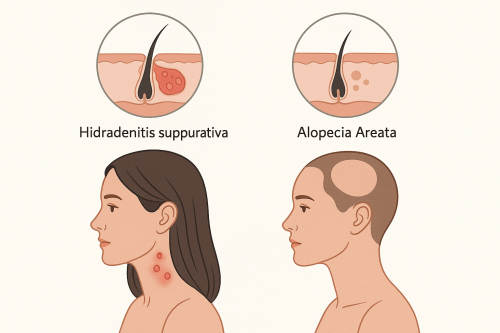
A 2025 study found that patients with hidradenitis suppurativa (HS), a chronic skin condition, have a 1.79-fold increased risk of developing alopecia areata (AA), an autoimmune disorder causing hair loss, compared to those without HS. Researchers highlight the shared inflammatory pathways between HS and AA, suggesting a need for further studies on their immunological connection.
Recent research has explored the potential link between hidradenitis suppurativa (HS) and alopecia areata (AA), two conditions that share similar inflammatory pathways. HS is a chronic skin condition, while AA is an autoimmune disorder that causes hair loss. The study aimed to find out if people with HS have a higher risk of developing AA.
Understanding the Study Approach
This research was a multicenter cohort study using data from the TriNetX Research Network, which includes electronic health records from over 120 healthcare organizations. The study involved patients diagnosed with HS from 2008 to 2023 and compared them with a control group without HS. The researchers used a technique called propensity score matching to ensure both groups were similar in age, gender, and other factors, making the comparison fairer.
Key Findings
The study found that patients with HS had a 1.79-fold higher risk of developing AA over a 15-year period compared to those without HS. This increased risk was consistent in shorter follow-ups of 3 and 8 years as well. Specifically, female patients with HS were 1.75 times more likely to develop AA than females without HS. However, this trend was not seen in male patients.
Implications for Patients and Caregivers
The association between HS and AA suggests that people with HS should be aware of the potential risk of developing AA. Clinicians might consider monitoring for signs of AA in HS patients, especially in females, to manage any emerging symptoms early. Understanding the link could also guide future research and treatment strategies for both conditions.
Limitations and Areas for Future Research
There are some limitations to this study. As it relied on electronic health records, there might be misclassification or missing data. The study was based on a US population, so the findings may not be applicable to other groups. Additionally, the study did not include children under 20, limiting its insights into younger patients. Future research should delve into the biological mechanisms connecting HS and AA and explore these associations in more diverse populations.
In conclusion, this study highlights a potential risk of alopecia areata among patients with hidradenitis suppurativa. While these findings underscore the importance of monitoring, more research is needed to fully understand the relationship and its implications across different populations.
Author(s)
Shuo-Yan Gau, Chih-Wei Chen, Yu-Hsun Wang, Ching-Chi Chi, James Cheng-Chung Wei