 English
 Spanish
 French
 Italian
 German

MARCH 11, 2024
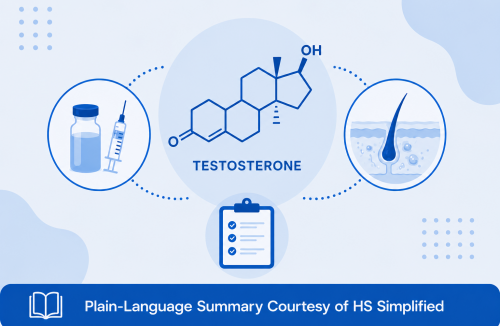
Lack of association of exogenous testosterone administration with exacerbation of preexisting hidradenitis suppurativa
Summary Verified By: Alexandra Charrow, M.D. | Mass General Brigham
March 11, 2024
This plain-language research summary was generated by AI, courtesy of HS Simplified.
In a study conducted between 2016 and 2022, researchers investigated whether exogenous testosterone (ET) could worsen preexisting hidradenitis suppurativa (HS), finding no significant link. Patients without prior exacerbations before ET therapy generally remained stable. This suggests the need for further research to understand how androgens contribute to HS and how antiandrogen medications work.
What Did the Researchers Do?
A group of scientists looked at patients who already had HS and then started taking exogenous testosterone (ET)—that means testosterone that comes from medicine, not from the body. They wanted to see if these patients had more HS flare-ups after starting testosterone. They checked the medical records of people who had both HS and a prescription for testosterone at a big hospital group from 2016 to 2022. They checked if people had HS flare-ups (bad periods needing extra help or hospital visits) in the 6 months before and after they started taking testosterone.
What Did They Find?
The study included 31 patients, most of them men, and the average age was about 48 years old. Before starting testosterone, 7 people had at least one flare-up in the 6 months before. After starting testosterone, 2 of those 7 kept having flare-ups, but 5 stayed the same. On the other hand, out of the 24 people who hadn’t had a flare-up before testosterone, only 2 had a flare-up after starting it. When the scientists did the math, they found there wasn’t a strong link between taking testosterone and having more HS problems. This means that, for most people, taking testosterone did not make HS worse.
What Does This Mean?
The results suggest that testosterone medicine probably doesn't cause more flare-ups of HS for most people. People who hadn’t had problems before starting testosterone usually didn’t have problems afterward, either. Even for those who had flare-ups before, most didn’t get worse on testosterone. However, this doesn’t mean testosterone is totally safe for everyone with HS—just that there isn’t a clear pattern showing it always makes things worse.
Limitations of the Study
There are some important limits to this study. First, the study only had 31 people, so it’s hard to know if the results are true for everyone. Most of the people were cis-gendered men, meaning we have less information about transgendered men and women. Also, the study only looked back at people’s medical charts, not forward, so it can’t prove what caused what. Finally, people with severe HS might not have been given testosterone at all, so they weren’t in the study. The researchers think bigger, better studies are needed to know for sure.
What’s Next?
Scientists still want to learn more about how hormones like testosterone and medicines that change hormone levels (like spironolactone or finasteride) affect HS. This study is a good first step, but more research is needed to give clear answers for everyone with HS who might need hormone treatments.
Author(s)
Kanika Kamal, Najiba Afzal, Amina Ziad, Karla Santiago-Soltero, Alexandra Charrow
Read Original Paper
https://pmc.ncbi.nlm.nih.gov/articles/PMC11033186/