 English
 Spanish
 French
 Italian
 German

OCTOBER 31, 2015
Local wound care and topical management of hidradenitis suppurativa
Summary Verified By: Afsaneh Alavi, M.D. | Mayo Clinic
October 31, 2015
This plain-language research summary was generated by AI, courtesy of HS Simplified.
Local wound care and topical management of hidradenitis suppurativa
In their 2015 article, Alavi and Kirsner explore the challenges and strategies in managing hidradenitis suppurativa (HS), a chronic skin condition affecting areas with sweat glands, through topical treatments and wound care. HS is characterized by painful, recurrent boils and abscesses, and its management requires careful consideration of topical antibiotics like clindamycin and keratolytic agents which help in the early stages. The article emphasizes that while wound care can improve the quality of life for sufferers, optimized treatments need further research, highlighting the disease's complex nature and the necessity for a multidisciplinary approach.
Understanding Wound Care for Hidradenitis Suppurativa (HS)
Hidradenitis Suppurativa (HS) is a long-lasting skin disease that causes painful bumps, tunnels, and wounds, mostly in places where your skin folds, like your armpits or groin. These spots can leak fluid, smell bad, and really hurt. Because it keeps coming back and can make daily life hard, doctors are always looking for better ways to care for these wounds.
Why Does HS Happen?
No one knows for sure what causes HS, but Alavi and Kirsner explain that it might start when hair follicles (tiny holes in your skin where hair grows) get blocked, and the body’s immune system reacts to bacteria that normally live on our skin. This causes swelling, infection, and those painful lumps.
How Do Doctors Treat the Skin?
Doctors use topical therapies (medicines you put on your skin) in the early stages of HS. The most common one is clindamycin cream, which is an antibiotic that kills bacteria. Some people also use resorcinol (helps shed dead skin), or retinoids (vitamin A creams that help unblock follicles). These treatments can shrink lumps and stop new ones from forming, but they don’t work for everyone. There isn’t a lot of strong proof yet about which cream works best.
Keeping Wounds Clean
Keeping the wounds clean is very important. Doctors suggest washing with gentle cleansers, like sterile water or saline (salt water), since these don’t hurt the skin. Some people use antiseptics (germ-killing solutions), but these can sometimes cause skin irritation. So, it’s a balance between killing germs and not hurting the skin more.
What About Dressings?
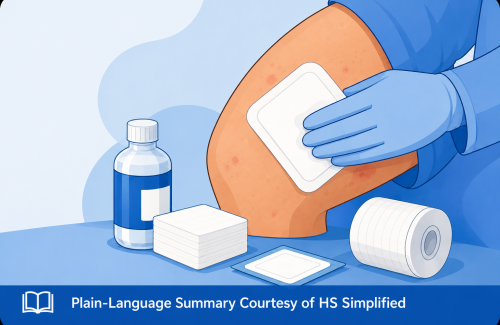
Covering the wounds with the right dressing is key. The best type depends on where the wound is and how much it leaks. For deep wounds, dressings that absorb lots of liquid and fill the empty spaces work best. For shallow wounds, simple absorbent pads are enough. Using soft, non-sticky dressings can make changing them less painful and protect the skin around the wound.
Special Wound Care After Surgery
Sometimes, people with HS need surgery to remove the affected damaged skin and scars. After surgery, wounds need special care to heal. A treatment called negative pressure wound therapy (NPWT) uses a gentle vacuum to help the wound heal faster by pulling out extra fluid, reducing bacteria, and helping new tissue grow. This is especially helpful for big, deep wounds after surgery.
Limitations and What’s Still Unknown
One of the biggest problems is that scientists don’t have a lot of strong, long-term proof about which creams or dressings work best for HS. Most studies are small or only describe a few cases. This means we still need better research to know which wound care methods are best for different people.
Why Good Wound Care Matters
Even though there is no cure for HS yet, taking care of wounds the right way can reduce pain, stop infections, and make life easier for those who have it. Alavi and Kirsner say that doctors, nurses, and sometimes even surgeons need to work together to help patients with HS get the best care.
Author(s)
Afsaneh Alavi, Robert S Kirsner
Read the Original Paper
https://www.jaad.org/article/S0190-9622(15)01996-9/abstract