 English
 Spanish
 French
 Italian
 German

DECEMBER 1, 2025
Making Surgery Results Clearer for HS
Summary Verified By: Christopher Sayed, M.D. | UNC School of Medicine
December 1, 2025
This plain-language research summary was generated by AI, courtesy of HS Simplified.
Making Surgery Results Clearer for HS
In 2025, experts established a standardized set of definitions for surgical outcomes following procedures for hidradenitis suppurativa (HS), a chronic skin condition causing painful abscesses. The Delphi consensus method was used to reach agreement on terms like "persistence" and "progression" to better categorize and track patient outcomes. This is a pivotal step towards unifying how surgical results are reported, allowing for better comparison across studies and potentially improving patient care for those with HS.
Making Surgery Results Clearer for Hidradenitis Suppurativa
Hidradenitis suppurativa (HS) is a long-lasting skin disease. It causes sore lumps, abscesses (pockets of pus), and tunnels under the skin. These problems often show up in places where skin touches skin, like the armpits or groin. Because HS can be hard to treat with just medicine, surgery is sometimes needed to remove the worst spots.
Why Was This Study Done?
Doctors have done many studies on how well surgery works for HS. But until now, there was no standard way to talk about what happens after surgery—like if the disease comes back or gets worse. This made it hard to compare results from different studies. Westerkam and a group of experts wanted to create clear definitions for the outcomes of HS surgery, so everyone could measure and report things the same way.
How Did They Do It?
The researchers used a method called the Delphi process. This means they sent out surveys to a group of HS experts (mostly doctors and surgeons from the US and Europe) and asked them to agree on the best words and definitions to use for surgery results. They did this in two rounds, adjusting the definitions after the first round based on feedback.
What Did the Experts Agree On?
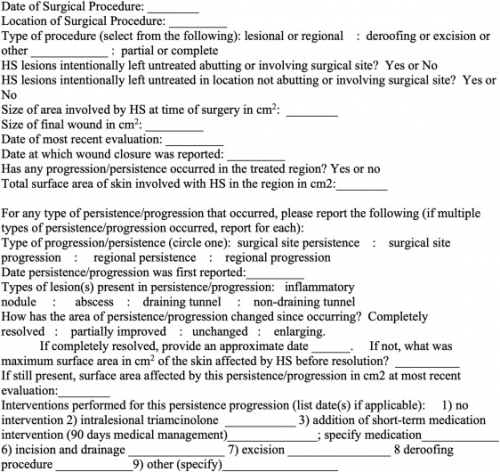
The experts agreed on four main terms to describe what can happen after HS surgery:
- Surgical site persistence: Some HS lumps or tunnels are still at or next to the spot that was operated on, either right after surgery or within 2 weeks of healing.
- Regional persistence: Some HS spots are still found in the larger area that was treated, but not right next to the surgical cut.
- Surgical site progression: New HS lumps or tunnels show up at or near the surgical spot, but only after at least 2 weeks of healing.
- Regional progression: New HS lumps or tunnels show up in the treated area, but not right next to where the surgery was done, also after 2 weeks of healing.
They also agreed on what extra details doctors should report, such as:
- How much time has passed since surgery
- What kind of HS lumps or tunnels are there
- How big the affected area is (measured in square centimeters)
- What treatments were needed after surgery (like more surgery or medicine)
- Whether the problem resolved, got better, stayed the same, or got worse
Why Is This Important?
Having standard definitions means that doctors everywhere can describe what happens after HS surgery in the same way. This makes it easier to compare how well different treatments work and helps researchers find out what really helps people with HS. It also helps patients and doctors understand what to expect after surgery.
Limitations of the Study
There were some limitations. Only 25 experts (mostly from the US and Europe) took part, so opinions from other parts of the world may be missing. Also, the study focused only on HS, not other diseases. Finally, some things, like measuring the exact size of wounds, can be tricky and may not be perfect.
What's Next?
Next, doctors and researchers will try using these new definitions in real studies to see how well they work. Over time, these standards will make research on HS surgery more reliable and help improve care for people living with this painful skin condition.
In summary: Westerkam and colleagues created a set of clear rules for describing what happens after HS surgery. This will make future studies better and help patients get the best care possible.
Author(s)
Linnea L Westerkam, Hessel H van der Zee, Falk G Bechara, Stephanie Goldberg, Gregor B Jemec, Julie Caffrey, Abigail Chaffin, Ernest S Chiu, Lynn Damitz, Steven Daveluy, Amit Garg, Ralph George, Philippe Guillem, Iltefat H Hamzavi, Paul G Hazen, Barbara Horvath, John R Ingram, Joslyn S Kirby, Lukasz Matusiak, Lauren A V Orenstein, Dennis P Orgill, Venessa Pena-Robichaux, Maurizio Podda, Errol Prens, Barry Resnik, Ditte Marie Lindhardt Saunte, Drew K Saylor, Linnea Thorlacius, Bente Villumsen, Allard R J V Vossen, Christopher J Sayed
Read Original Paper
https://www.jaad.org/article/S0190-9622(25)02668-4/abstract