 English
 Spanish
 French
 Italian
 German

APRIL 2, 2025
No association between adalimumab use and heart failure in patients with hidradenitis suppurativa: A propensity matched study
Summary Verified By: Sherry Yang, M.D. | Jefferson Health
April 2, 2025
This plain-language research summary was generated by AI, courtesy of HS Simplified.
No association between adalimumab use and heart failure in patients with hidradenitis suppurativa: A propensity matched study
In a 2025 study, researchers investigated the link between adalimumab, a medication for hidradenitis suppurativa (a chronic skin condition), and heart failure risk. Despite concerns, adalimumab didn't significantly impact new or worsening heart failure in patients compared to controls. This study suggests that adalimumab does not exacerbate heart issues related to tumor necrosis factor inhibitors (medications that block a specific protein involved in inflammation) in these patients.
Does Adalimumab Increase Heart Failure Risk in HS Patients?
Hidradenitis suppurativa (HS) is a long-lasting skin disease that causes painful bumps and sores, mostly in younger people. People with HS often have other health problems, like heart disease. Some doctors have worried that medicines used to treat HS, such as adalimumab (a medication that blocks a protein called tumor necrosis factor-alpha, or TNF-alpha), might increase the risk of heart failure (HF). Heart failure happens when the heart can't pump blood as well as it should.
This concern comes from older studies, where a similar medicine was linked to more heart failure in people already sick with heart problems. But newer research has had mixed results, so Dr. Pakhchanian and colleagues wanted to see if adalimumab really affects heart failure risk in people with HS.
How Did the Study Work?
The researchers looked back at medical records from over 110 million patients in a large database. They found adults with HS who did not already have heart failure, and split them into two groups: those who took adalimumab within a year of their HS diagnosis, and those who did not. They also checked what happened to people with HS who already had heart failure, to see if adalimumab made things worse.
To make sure the groups were as similar as possible, the experimenters matched people by age, gender, and other health problems. This helps compare the two groups fairly.
What Did They Find?
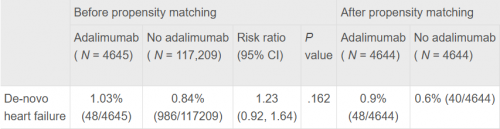
In the end, out of about 122,000 people with HS, only 3.8% got adalimumab. After carefully matching, they found no significant difference in the number of people who developed new heart failure between those who took adalimumab and those who did not. The same was true for people who already had heart failure—taking adalimumab did not make their heart failure worse.
In both groups, heart failure was still very rare.
What Does This Mean?
These results are good news for people with HS who need adalimumab: this medicine does not appear to increase the risk of getting heart failure or making it worse. This agrees with other recent studies of TNF-blocker medicines in different diseases.
Limitations
There are some things to keep in mind about this study. Since the researchers used medical records, some information might be missing or recorded incorrectly. They couldn't tell how severe each person's HS was or how long they took adalimumab. Also, doctors might avoid giving adalimumab to patients they think are at high risk for heart failure, which could change the results.
More research is needed, especially with more details about each patient, to make sure these results are correct.
In summary: For people with hidradenitis suppurativa, using adalimumab does not seem to raise the chance of heart failure, but doctors should still watch their patients carefully and new studies could help confirm these findings.
Author(s)
Haig Pakhchanian, Rahul Raiker, Charles DeYoung, Shalini Krishnasamy, Arka Chatterjee, Sherry Yang
Read Original Paper
https://www.jaad.org/article/S0190-9622(24)03117-7/abstract