 English
 Spanish
 French
 Italian
 German

APRIL 5, 2023
Patient Perspectives of Health System Barriers to Accessing Care for Hidradenitis Suppurativa
Summary Verified By: Leandra Barnes, M.D. | Stanford Medicine
April 5, 2023
This plain-language research summary was generated by AI, courtesy of HS Simplified.
Patient Perspectives of Health System Barriers to Accessing Care for Hidradenitis Suppurativa
Hidradenitis suppurativa (HS), a painful, chronic skin condition, faces an alarming average diagnostic delay of 7 to 10 years in the US. A 2023 study highlights barriers such as employment-linked health insurance and costs that hinder access to care, often exacerbating disease activity. Understanding and addressing these hurdles can improve patient-centered care and maximize health outcomes.
Understanding Barriers to Care for People with Hidradenitis Suppurativa (HS)
Hidradenitis suppurativa (HS) is a painful long-term skin disease. It causes swollen bumps and boils, usually in the armpits or groin, that come back over and over. These bumps can hurt, leak fluid, and leave scars. HS affects about 1 out of every 100 people in the U.S., especially women and Black Americans. Many people with HS have trouble getting the right medical care, often waiting 7 to 10 years before getting a correct diagnosis.
What Did the Study Look At?
Dr. Barnes and her team wanted to understand what makes it hard for people with HS to get the care they need. They spoke with 45 adults with HS from diverse backgrounds. Each person did a 1-hour interview about their experiences with doctors, insurance, and the costs of care. The researchers looked for common themes or problems that came up in the interviews.
Six Big Barriers to Getting Care
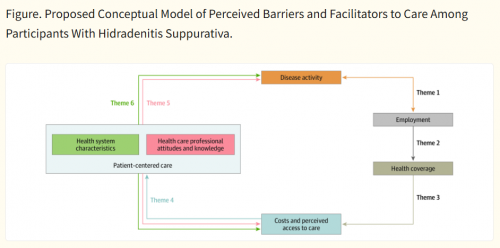
The researchers found six main reasons people with HS have trouble getting treatment:
-
HS affects jobs and jobs affect HS: HS can make it hard to work because of pain or doctor visits, but some jobs (like those that need a lot of sitting or moving) can also make HS worse. Some people end up needing disability benefits.
-
Health insurance depends on employment: Many people keep tough jobs just to keep their health insurance, a situation sometimes called "job lock."
-
Insurance affects costs and access: The type of insurance someone has can make it easier or harder to see a specialist or get medicine. Sometimes, even with insurance, co-pays (the amount you pay each time you see a doctor) are too high.
-
High costs block patient-centered care: Seeing doctors, buying medicine, traveling to appointments, and paying for supplies like bandages all add up. The time and money can be so much that people skip care they need.
-
Doctors’ attitudes and knowledge matter: Some doctors do not know much about HS or may not be respectful or understanding. This can make patients feel ashamed or not listened to, and less likely to go back for care.
-
The health system itself can be confusing: It can be hard to find the right kind of doctor, get quick appointments for severe flare-ups, or have doctors who work together. Sometimes, people have to travel far to see a specialist.
Why Does This Matter?
All these problems can work together to make things worse for people with HS. For example, missing work means less money, which can mean losing insurance, which makes it harder to see a doctor, and so on. At the same time, not getting care can make HS worse, leading to more pain and even more problems with work or school.
What Could Help?
The study suggests a few things that might make life better for people with HS:
-
Making it easier to see doctors who know about HS.
-
Helping doctors learn how to talk kindly and clearly about HS.
-
Making sure insurance covers more of the real costs, including supplies and travel.
-
Letting patients see different kinds of doctors who work together as a team.
Study Limitations
This study had some limits. All interviews were with adults, so we do not know what kids with HS experience. The study did not measure how severe each person’s HS was. Also, the research focused on what people said, not medical records or doctor opinions. Still, because the group was diverse, the findings are useful for understanding many people's experiences.
The Big Picture
Dr. Barnes and her team showed that people with HS face many connected barriers that make getting care hard. Tackling even one part of the problem—like helping doctors understand HS better—could help break the cycle. This research helps doctors, health systems, and patients see where changes are most needed to make care fairer and easier for people living with HS.
Author(s)
Leandra A. Barnes, Neha Shukla, Maia Paul, Isabella de Vere Hunt, Meghan C. Halley, Eleni Linos, Haley B. Naik
Read Original Paper
https://jamanetwork.com/journals/jamadermatology/fullarticle/2803650