 English
 Spanish
 French
 Italian
 German

MAY 17, 2024
Positive correlation of hidradenitis suppurativa and ultra-processed foods consumption
Summary Verified By: Luis Garza, M.D. Ph.D. | Johns Hopkins
May 17, 2024
This plain-language research summary was generated by AI, courtesy of HS Simplified.
Positive correlation of hidradenitis suppurativa and ultra-processed foods consumption
A 2024 study reveals a potential link between hidradenitis suppurativa (HS), a chronic skin condition, and consumption of ultra-processed foods (UPFs), rather than obesity alone. UPFs, foods with high levels of additives and preservatives, seem to correlate with increased HS prevalence, suggesting that limiting these foods could improve HS symptoms. Further research addressing dietary habits could be beneficial for those affected by this condition.
What Did This Study Look At?
Hidradenitis suppurativa (HS) is a skin disease that causes painful lumps, abscesses (collections of pus), and scars, usually in places where skin rubs together, like the armpits or groin. Doctors don't fully know what causes HS, but they think genetics, hormones, obesity, and diet might play a role.
Why Focus on Food?
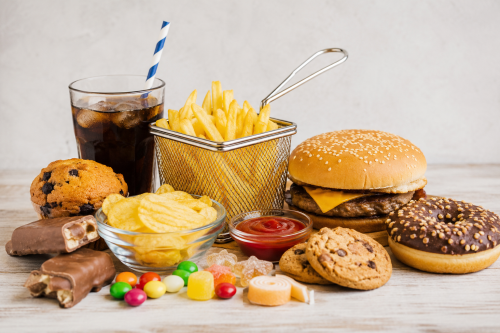
Ultra-processed foods (UPFs) are foods that have been changed a lot from their original form and often contain added sugars, fats, and chemicals. Examples are chips, soda, and packaged sweets. Minimally processed foods (MPFs) are closer to how they start out, like fresh fruits, vegetables, or plain meat.
Scientists Haddad and her team noticed that people who eat more ultra-processed foods seem to have more HS. For example, Non-Hispanic Black people in the US have the highest HS rates, obesity rates, and UPF eating rates. But Hispanic people, who also have high obesity rates, eat fewer UPFs and have less HS. This made the researchers wonder if eating UPFs is more important for HS than just being overweight.
How Did the Scientists Study This?
The team compared lots of data from different places:
- How much people searched for HS on Google in different countries and US states
- How common HS is in these places
- How much ultra-processed food and minimally processed food people eat, by race and age
They used statistics to see if there were patterns between these things.
What Did They Find?
Haddad and her group found a strong link between eating more ultra-processed foods and having more HS. This was true when looking at different countries and at US states. Places where people ate more UPFs also had more Google searches for HS, which suggests more people have or wonder about the disease.
Over the years, as people in the US ate more UPFs, Google searches for HS also went up. At the same time, eating minimally processed foods went down, and HS searches went up. This means that as people ate more junk food and less fresh food, HS seemed to get more common.
These patterns were not seen with another skin disease, melanoma, which suggests the finding is special to HS.
What Does This Mean?
The study suggests that eating a lot of ultra-processed foods might be related to getting HS. Eating more minimally processed foods might help protect against it. But, this study can't prove that these foods cause HS, only that they seem to be linked.
Limitations and Next Steps
There are some limitations to this study. The scientists mostly used data from the internet and surveys, not from people being tested directly. Also, just because people search for HS online doesn't always mean they have it.
More research is needed to see if eating fewer ultra-processed foods can really help people avoid or improve HS. It would help to include things like body mass index (BMI), which measures if someone is overweight, to see if the effect is from diet or weight.
Takeaway
If you want to help your skin, try eating more fresh, less processed foods and fewer packaged or junk foods. This might help lower your chance of getting HS, but we need more science to know for sure.
Author(s)
Nina Rossa Haddad, Beita Badiei, Kaitlin L. Williams, Luis A. Garza
Read Original Paper
https://link.springer.com/article/10.1007/s00403-024-02947-9