 English
 Spanish
 French
 Italian
 German

MARCH 4, 2023
Secukinumab in Moderate-to-Severe HS Patients (SUNSHINE and SUNRISE Phase 3 Trials)
Summary Verified By: Alexa Kimball, MD, MPH | Harvard Medical Faculty Physicians at Beth Israel Deaconess Medical Center
March 4, 2023
This plain-language research summary was generated by AI, courtesy of HS Simplified.
Secukinumab in Moderate-to-Severe HS Patients (SUNSHINE and SUNRISE Phase 3 Trials)
This study tested secukinumab, a medication that blocks the inflammatory signal IL-17A. People receiving secukinumab every two weeks were more likely to improve than those on placebo, with benefits lasting up to one year. The medication was generally well tolerated with no unexpected safety issues.
The SUNSHINE and SUNRISE trials were the largest global hidradenitis biologic trials at the time of their publication, enrolling over 1,000 participants across 40 countries. Conducted between 2019 and 2021, the studies were led by international academic investigators and sponsored by Novartis.
What is secukinumab and how does it work?
Secukinumab is a monoclonal antibody that blocks IL-17A, an inflammatory signal involved in immune cell recruitment and tissue inflammation. IL-17A plays a central role in many inflammatory skin diseases and is elevated in hidradenitis lesions.
What did the study test?
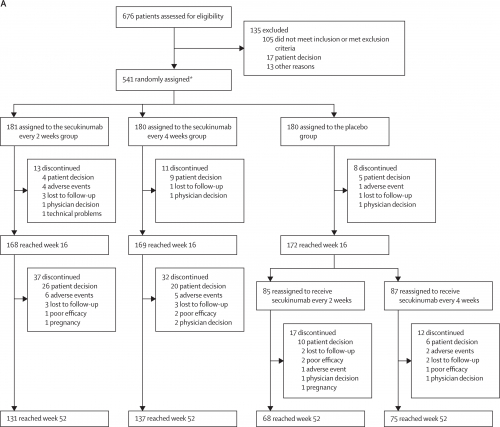
Two identical phase 3 trials compared secukinumab given every 2 weeks or every 4 weeks versus placebo. The primary outcome measured whether patients achieved a 50% reduction in abscesses and inflammatory nodules by week 16, with follow-up to week 52.
What did the study find?
Around 40-45% of patients receiving secukinumab every 2 weeks were significantly more likely to improve than those receiving placebo (around 31-34% improvement) in both trials. Benefits were maintained for up to one year. Results for every-4-week dosing were more variable between trials.
Side effects and safety profile
The most common side effects were headache and mild infections. Overall, secukinumab had a favorable safety profile, consistent with its long-term use in other inflammatory conditions.
What were the study’s limitations? All patients were required to use daily topical over-the-counter which may have affected the results. The study design allowed use of rescue medications including antibiotics and other interventions, which while ethically necessary, introduces variability. Similarly, patients on stable doses of selected antibiotics (tetracycline, minocycline, or doxycycline) were eligible to participate.
What does this matter? (Takeaways)
These trials confirmed IL-17A as a valid treatment target and expanded biologic options beyond TNF-α inhibitors. Secukinumab offers an important alternative for patients needing different immune-targeting approaches.
Author(s)
Alexa B Kimball, Gregor B E Jemec, Afsaneh Alavi, Ziad Reguiai, Alice B Gottlieb, Falk G Bechara, Carle Paul, Evangelos J Giamarellos Bourboulis, Axel P Villani, Andreas Schwinn, Franziska Ruëff, Larisha Pillay Ramaya, Adam Reich, Ines Lobo, Rodney Sinclair, Thierry Passeron, Antonio Martorell, Pedro Mendes-Bastos, Georgios Kokolakis, Pierre-Andre Becherel, Magdalena B Wozniak, Angela Llobet Martinez, Xiaoling Wei, Lorenz Uhlmann, Anna Passera, Deborah Keefe, Ruvie Martin, Clarice Field, Li Chen, Marc Vandemeulebroecke, Shoba Ravichandran, Elisa Muscianisi
Read Original Paper
https://www.thelancet.com/journals/lancet/article/PIIS0140-6736(23)00022-3/abstract