 English
 Spanish
 French
 Italian
 German

AUGUST 1, 2025
Therapeutic drug monitoring in hidradenitis suppurativa patients on adalimumab: A retrospective cohort
Summary Verified By: Afsaneh Alavi, M.D. | Mayo Clinic
August 1, 2025
This plain-language research summary was generated by AI, courtesy of HS Simplified.
Therapeutic drug monitoring in hidradenitis suppurativa patients on adalimumab: A retrospective cohort
In this 2025 study, therapeutic drug monitoring (TDM)—assessing serum drug levels and antibodies—revealed insights into treating hidradenitis suppurativa (HS) with adalimumab. Notably, responders showed higher drug concentrations, while suboptimal responders had detectable anti-adalimumab antibodies, impacting efficacy. This highlights TDM's potential in personalized HS management despite existing barriers like cost and interpretation challenges.
Can Measuring Medication Levels Help Skin Disease Patients?
Hidradenitis suppurativa (HS) is a painful skin condition where people get lumps and tunnels under the skin, often in areas like the armpits or groin. Doctors sometimes use a medicine called adalimumab to help, especially when HS is moderate or severe. Adalimumab is a type of biologic therapy, which means it targets specific parts of the immune system to reduce inflammation.
What Did the Experimenters Want to Know?
Yang and her team at the Mayo Clinic wanted to see if measuring the amount of adalimumab in patients’ blood could help predict who would get better from HS. This process is called therapeutic drug monitoring (TDM). Sometimes, people’s bodies make antibodies (special proteins that attack things seen as “foreign") against adalimumab, called anti-adalimumab antibodies (AAAs). These antibodies can stop the medicine from working.
How Did They Study This?
The experimenters looked at 67 HS patients who had their blood tested for adalimumab levels at the Mayo Clinic from 2018 to 2023. They divided the patients into three groups:
-
Responders: People who got better after 12 weeks of medicine
-
Primary suboptimal responders: People who did not get better at all after 12 weeks
-
Secondary suboptimal responders: People who got better at first but got worse again later
They checked the amount of medicine in the blood, and whether the patients had anti-adalimumab antibodies.
What Did They Find?
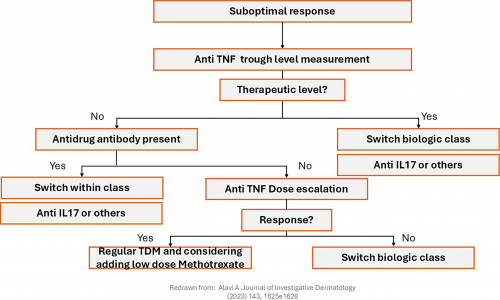
The patients who got better (responders) had higher amounts of adalimumab in their blood (about 9.8 micrograms per milliliter) than those who did not respond well (about 6.0 micrograms per milliliter). Also, people who did not respond well were more likely to have anti-adalimumab antibodies in their blood, which can block the medicine from working. This means that measuring drug levels and antibodies could help doctors figure out why someone’s treatment isn’t working.
Limitations of the Study
This study had some limitations:
-
It was retrospective, meaning the researchers looked back at old records instead of planning everything ahead of time.
-
The sample size was small (only 67 patients).
-
They did not have exact counts of skin lumps for most people, so they relied on doctors’ notes.
-
Follow-up was not always consistent.
Because of these things, the results are helpful but not perfect. More research is needed to know for sure how useful drug monitoring is for HS.
Why Is This Important?
If doctors can use drug level testing to predict who will do well on adalimumab, they could make better treatment choices and help patients get the right medication faster. This could mean fewer side effects, less wasted time, and better control of painful skin symptoms for people with HS.
Author(s)
Eilene Yang, Stella X Chen, Vahide Saeidi, Christian Baum, Giang Nguyen, Austin Todd, Jordan Haag, Afsaneh Alavi
Read Original Paper
https://www.jaad.org/article/S0190-9622(25)00569-9/abstract