 English
 Spanish
 French
 Italian
 German


FEBRUARY 2, 2025
Topical Tranexamic Acid Application for Hidradenitis Suppurativa Procedures
Summary Verified By: Mikael Horissian, M.D. | Geisinger Medical Center
February 2, 2025
This plain-language research summary was generated by AI, courtesy of HS Simplified.
Topical Tranexamic Acid Application for Hidradenitis Suppurativa Procedures
A 2025 publication discussed a method of using topical tranexamic acid (TXA), a medication that reduces bleeding, applied with petrolatum to improve healing and minimize bleeding after skin surgeries for hidradenitis suppurativa — a chronic skin condition causing painful nodules.
Using Tranexamic Acid to Reduce Bleeding After Surgery for Hidradenitis Suppurativa
Surgery for hidradenitis suppurativa (HS) often involves removing affected skin areas, which can leave large wounds that may bleed after the procedure. Controlling this bleeding is important but can be challenging. Tranexamic acid (TXA) is a medicine known to reduce bleeding during surgery. While it is usually given through an IV, this method can be difficult to use in dermatology clinics and might carry some risks like blood clots. Applying TXA directly to the wound (topical use) has been shown to reduce bleeding in other types of skin surgeries, but until now, it has not been reported for use in HS surgeries.
How TXA is Applied in HS Surgery
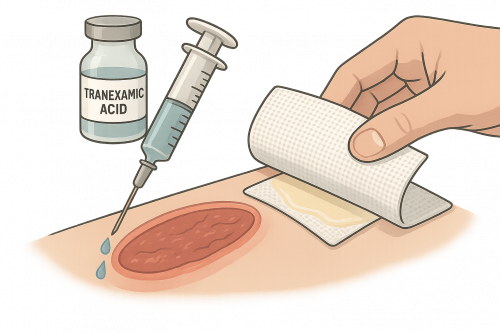
In the clinic described by the researchers, they use a simple method to apply TXA right onto the wound after surgery. They carefully pour a small amount (1 to 3 mL) of TXA solution directly into the open wound using a syringe. Then, they immediately cover the wound with gauze that has a layer of petrolatum (a type of ointment). This “traps” the TXA inside the wound and helps prevent it from drying out or rubbing off. After that, a normal absorbent bandage is placed on top. Patients are told to keep the bandage on for 24 to 48 hours unless it becomes soaked with fluid.
This "pour and trap" approach has helped reduce the number of patients who experience bleeding after HS surgery. The authors note that this method is better than soaking the gauze in TXA beforehand, because soaked gauze can stick to the wound and remove healing clots when the bandage is changed.
What This Means for Patients and Doctors
This technique offers a practical and easy way for dermatologists to help control bleeding after HS surgeries without needing IV medications. It may also help wounds heal better by protecting the clot and reducing bleeding complications. However, this report is based on clinical experience rather than a formal study, so more research is needed to confirm how well this method works and whether it is safe for everyone.
The method was developed by Dr. Joselyn Kirby, and the authors hope other doctors will try it to improve care for people undergoing surgery for HS.
Author(s)
Nicholas D Flint, Mikael Horissian