 English
 Spanish
 French
 Italian
 German

AUGUST 3, 2016
Two Phase 3 Trials of Adalimumab for HS (Pioneer I and II)
Summary Verified By: Alexa Kimball, MD, MPH | Harvard Medical Faculty Physicians at Beth Israel Deaconess Medical Center
August 3, 2016
This plain-language research summary was generated by AI, courtesy of HS Simplified.
Two Phase 3 Trials of Adalimumab for HS (Pioneer I and II)
This study tested adalimumab, an injectable anti-inflammatory medication, to see if it could reduce painful lesions in people with moderate to severe hidradenitis. People receiving weekly adalimumab were more likely to have fewer abscesses and inflammatory nodules than those receiving placebo. Serious side effects were uncommon and similar between treatment and placebo groups.
This landmark study led to the first FDA-approved biologic treatment for hidradenitis. It evaluated whether blocking tumor necrosis factor-alpha (TNF-α), a key inflammatory signal in the immune system, could meaningfully improve symptoms and quality of life.
The trials were conducted between 2011 and 2014 at over 100 centers worldwide and sponsored by Abbvie.
What is adalimumab and how does it work?
Adalimumab is a monoclonal antibody that blocks TNF-α, a powerful immune messenger that drives inflammation. TNF-α is elevated in hidradenitis lesions, and blocking it can calm immune over-activation and reduce tissue damage. Adalimumab was already approved for other inflammatory diseases before this study.
What did the study test?
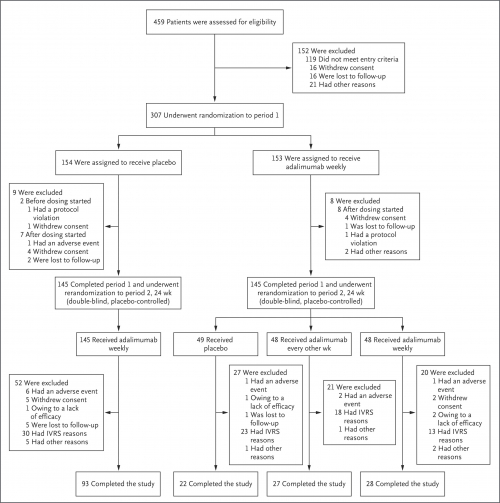
Two large phase 3 clinical trials (PIONEER I and II) tested weekly adalimumab injections versus placebo over 12 weeks, followed by longer-term treatment. The main outcome measured whether patients achieved at least a 50% reduction in abscesses and inflammatory nodules, without worsening drainage.
What did the study find?
People treated with weekly adalimumab were significantly more likely to improve than those on placebo. Between 40-60% of treated patients achieved meaningful improvement compared with about one quarter on placebo. Improvements in pain and lesion counts were also seen, particularly in one of the two trials.
Side effects and safety profile
Serious side effects were uncommon and occurred at similar rates in the adalimumab and placebo groups. Known risks of adalimumab include increased infection risk and injection-site reactions, consistent with its use in other inflammatory diseases.
What were the study’s limitations? In PIONEER II, 19% of patients continued concomitant tetracycline-class antibiotics during the trial, which may have confounded the results. Significant baseline differences existed between the two studies, with PIONEER I enrolling patients with higher baseline disease which may have led to lower responsiveness to therapy at week 12.
What does this matter? (Takeaways)
This study established adalimumab as the first proven biologic therapy for hidradenitis. It validated immune-targeted treatment and opened the door to newer therapies targeting additional inflammatory pathways.
Author(s)
Alexa B Kimball, Martin M Okun, David A Williams, Alice B Gottlieb, Kim A Papp, Christos C Zouboulis, April W Armstrong, Francisco Kerdel, Michael H Gold, Seth B Forman, Neil J Korman, Evangelos J Giamarellos-Bourboulis, Jeffrey J Crowley, Charles Lynde, Ziad Reguiai, Errol-Prospero Prens, Eihab Alwawi, Nael M Mostafa, Brett Pinsky, Murali Sundaram, Yihua Gu, Dawn M Carlson, Gregor B E Jemec
Read Original Paper
https://www.nejm.org/doi/10.1056/NEJMoa1504370