 English
 Spanish
 French
 Italian
 German

FEBRUARY 2, 2026
Vilobelimab May Improve Clinical Outcomes of HS Patients by Reducing Skin Tunnels
Summary Verified By: Christopher Sayed, M.D. | UNC School of Medicine
February 2, 2026
This plain-language research summary was generated by AI, courtesy of HS Simplified.
Vilobelimab May Improve Clinical Outcomes of HS Patients by Reducing Skin Tunnels
This study explored the use of vilobelimab, a monoclonal antibody that blocks complement C5a, in treating hidradenitis suppurativa (HS), a chronic skin condition causing painful nodules and abscesses. Although it didn't significantly outperform placebo on overall improvement, high-dose vilobelimab notably reduced skin tunnels. These results suggest further investigation into vilobelimab's potential for managing HS is warranted.
Can Vilobelimab Help People with Hidradenitis Suppurativa?
Hidradenitis suppurativa (HS) is a long-lasting skin disease that causes painful lumps, abscesses (pockets of pus), and tunnels under the skin—especially in areas like the armpits and groin. These tunnels, called draining tunnels, can leak pus and really affect a person's quality of life. Scientists know that a part of the immune system called complement C5a is often too high in people with HS, which might be why they get so much swelling and pus.
Some medicines try to block C5a to see if that helps people with HS. Vilobelimab is one of these medicines. It is a monoclonal antibody (a lab-made protein that targets a specific part of the immune system). In an earlier, smaller study, vilobelimab seemed to help some people with severe HS who didn’t get better with other treatments.
What Did the SHINE Study Test?
Because the early results were hopeful, Giamarellos-Bourboulis and other scientists decided to do a bigger test called the SHINE trial. They wanted to see if vilobelimab could help more people with moderate to severe HS. In this study, 177 adults with HS from nine countries got either a placebo (a fake treatment) or one of four different doses of vilobelimab. The study was double-blind, meaning neither the patients nor the doctors knew who got which treatment.
How Did They Measure Success?
The main way the researchers measured if the medicine worked was with something called HiSCR (Hidradenitis Suppurativa Clinical Response). This score looks at how much the lumps and abscesses improved after 16 weeks. They also looked at other things, like how many new flares happened, how many tunnels formed, and if people felt less pain or had a better quality of life.
What Did They Find?
The main result was a surprise. About 47% of people on placebo got better based on the HiSCR score—almost as many as those who got vilobelimab. Because so many people on placebo did well, it was hard to tell if vilobelimab made a real difference using this score.
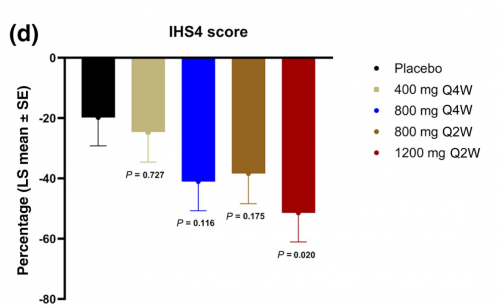
However, when the researchers looked more closely, they found that the highest dose of vilobelimab did help reduce the number of draining tunnels and the IHS4 score (a number that looks at how bad the disease is). This means the medicine might be good at shrinking the tunnels under the skin, which are a big problem for people with severe HS.
What About Side Effects?
The study found that vilobelimab was about as safe as the placebo. The most common side effects were infections (like colds) and some skin problems, but these happened at similar rates in both groups. Serious side effects were rare.
What Are the Limitations?
There were some important challenges with this study. For example, the HiSCR score might not be the best way to measure improvements in draining tunnels—since it's mostly about lumps and abscesses, not tunnels. Also, the people in the placebo group started out with fewer tunnels than some getting the medicine, which could make the results less clear. The high number of people getting better on placebo could be because of natural ups and downs in HS, or because the groups were small.
Finally, some participants had very different backgrounds (like different amounts of earlier treatments), and the way the medicine was given might not have been perfect for everyone.
What Does This Mean for Patients?
While vilobelimab did not clearly help more people get better based on the main score, it did seem to reduce draining tunnels when given at a high dose. This is important, because draining tunnels are one of the hardest parts of HS to treat. Scientists think that future studies should use better ways to measure improvements in tunnels, and might need to look at the treatment for longer or in different kinds of patients.
In summary, vilobelimab might help some people with very bad HS, especially with their draining tunnels, but more research is needed to be sure.
Author(s)
Evangelos J Giamarellos-Bourboulis, Gregor B E Jemec, Errol P Prens, Niels C Riedemann, Isabell Otto, Jamie Weisman, Grazyna Pulka, Roman J Nowicki, Vessel Kantardjiev, Andreas Pinter, Simon Francis Thomsen, Debra Berneman, Theodora Kanni, Afsaneh Alavi, Brigitte Breno, Melinda Gooderham, Melody Stone, Milan J Anadkat, Alexandros Katoulis, Markos Papakonstantis, Pierre-André Becherel, Jacek C Szepietowski, Hessel H van der Zee, Christos C Zouboulis, Christopher J Sayed
Read Original Paper
https://academic.oup.com/bjd/article/194/2/254/8284855